

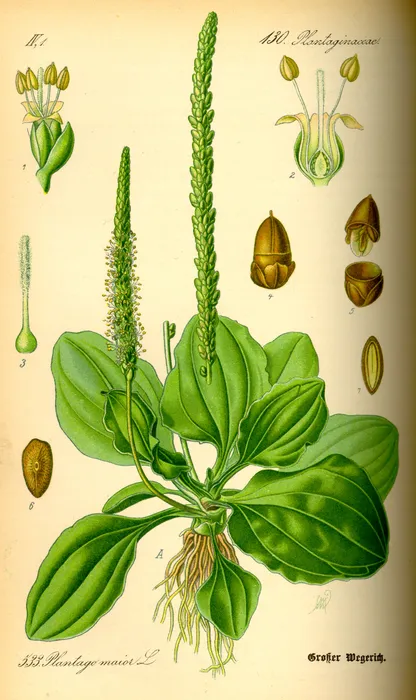
This is the common lawn/garden plantain (identify broadleaf Plantago major vs. narrowleaf Plantago lanceolata) — not the banana-like cooking fruit. A vulnerary and demulcent, traditionally valued in home herbalism for minor bites, stings, scrapes, and itchy or irritated skin, and an astringent that tones tissues.
Medicinal plant
Plantain
Plantago major
The go-to fresh poultice for bites and stings. Also called Broadleaf Plantain.
Uses
Skin — Herbs used in topical preparations, or traditionally associated with soothing and caring for the skin. First aid — Herbs kept for simple topical household use — minor skin irritation, bites, bumps, and similar everyday needs.
Properties
Vulnerary — Supports healing of wounds or damaged tissue
Demulcent — Coats, moistens, and soothes irritated internal tissues
Astringent — Tightens and tones tissues; often drying
Energetics
Cooling — Calms heat, irritation, or excess activity. Moistening — Adds or preserves moisture and soothes dryness. Toning — Firms, strengthens, or tightens tissues.
Similar herbs: Fireweed, Self-Heal, Jewelweed
Growing and using it
Life cycle
Herbaceous perennial.
Hardiness
Plantago major is listed across USDA Zones 3–12.
Harvesting
Harvest young leaves repeatedly during active growth.
Grow in zone
Harvest leaves — Gather leaves in these monthsHarvest leaves: MayHarvest leaves: JuneHarvest leaves: JulyHarvest leaves: AugustHarvest leaves: September
Existing patches usually need no cultivation.
Gardening tools
(Paid links)
Apply plantain fresh, crushed, or moistened, directly to the skin. Probably the most useful preparation in the entire garden.
Parts used
LeafPrepare
- Positively identify and wash a fresh plantain leaf
- Crush, mince, or mash until juicy
- Apply to a minor bite, sting, or superficial skin irritation
- Replace as it dries
Infuse plantain into a carrier oil for topical use in body oils, salves, and balms. Excellent for keeping plantain available outside the growing season.
Parts used
LeafPrepare
- Dry or thoroughly wilt clean leaves
- Chop
- Cover completely with carrier oil
- Infuse 2–4 weeks
- Strain very thoroughlyUse as an external skin oil, or as a salve base.