

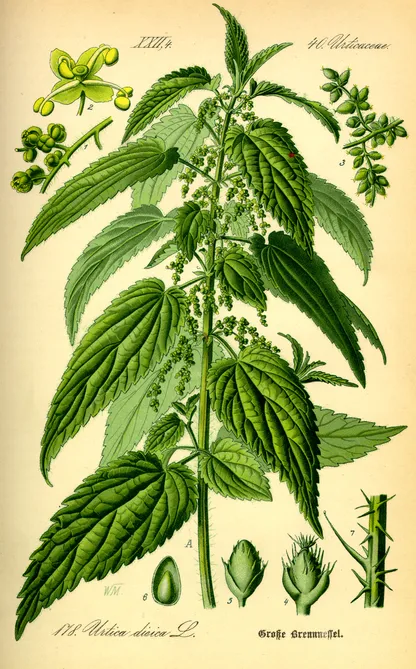
Stinging nettle is both a spring food and a traditional herbal tea. The young leaf is valued as a nutritive tonic and mild diuretic, and has a long history of alterative use. Cooking or drying neutralizes the fresh plant’s sting.
Medicinal plant
Nettle
Urtica dioica
A mineral-rich spring green and nourishing tea. Also called Nettle.
Properties
Nutritive — Provides nourishing minerals or other nutrients
Diuretic — Encourages urination and fluid elimination
Alterative — Traditionally supports gradual cleansing and elimination
Energetics
Cooling — Calms heat, irritation, or excess activity. Drying — Reduces excess moisture or secretions. Toning — Firms, strengthens, or tightens tissues.
Fresh nettles sting. Wear gloves while harvesting; cooking or thorough drying removes the sting.
Similar herbs: Raspberry, Red Clover, Self-Heal
Growing and using it
Life cycle
Herbaceous perennial that spreads vigorously by rhizomes.
Hardiness
Urtica dioica is hardy in USDA Zones 4–10.
How to start
Rooted plant or division for the fastest start; seed also works.
Starting from seed
Surface sow or barely cover; fall sowing or cold stratification can improve germination.
Harvesting
Harvest tender leaves before flowering and again from fresh regrowth after cutting.
Grow in zone
Start indoors — Sow under cover in trays or pots, before it is warm enough to sow outsideStart indoors: MarchStart indoors: AprilDirect sow — Sow straight into the ground where the plant will growDirect sow: AprilDirect sow: MayDirect sow: OctoberDirect sow: NovemberPlant out — Move a started plant into its final spot outdoorsPlant out: AprilPlant out: MayHarvest leaves — Gather leaves in these monthsHarvest leaves: AprilHarvest leaves: MayHarvest leaves: JuneHarvest leaves: SeptemberHarvest leaves: October
Cut before flowering for a flush of tender regrowth. Moist, fertile soil gives the best leaves.
Gardening tools
(Paid links)
Steep nettle in hot water to draw out its flavour and water-soluble properties. A simple way to use dried spring nettle leaf.
Parts used
Leaf DriedGather
Harvest leaves before flowering. Dry in a single layer out of direct sun until crisp.
Prepare
- Put the dried leaf in a heat-safe cup or jar
- Cover with boiling water
- Cover and steep 10–15 minutes, or longer for a stronger infusion
- Strain
Apothecary supplies
(Paid links)


Use nettle as food, seasoning, garnish, or an ingredient in everyday cooking. Young nettles can be cooked anywhere you would use another tender green.
Parts used
LeafPrepare
- Harvest young leaves with gloves
- Rinse well
- Steam, blanch, or sauté until fully wilted
- Use in soups, eggs, pasta, pesto, or as a cooked green